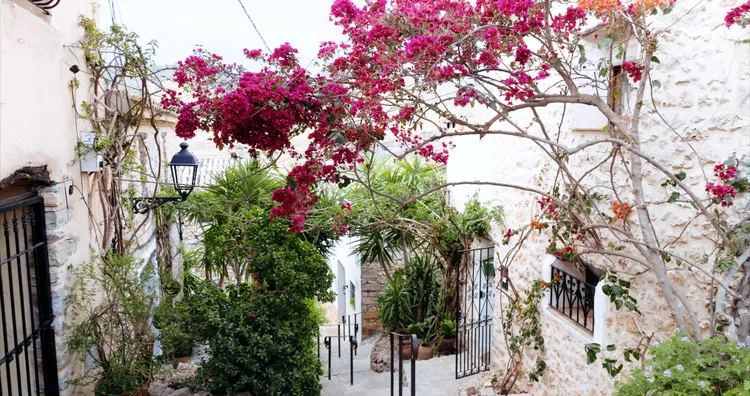
Your Story Told in Spain: A Film-First Timeline
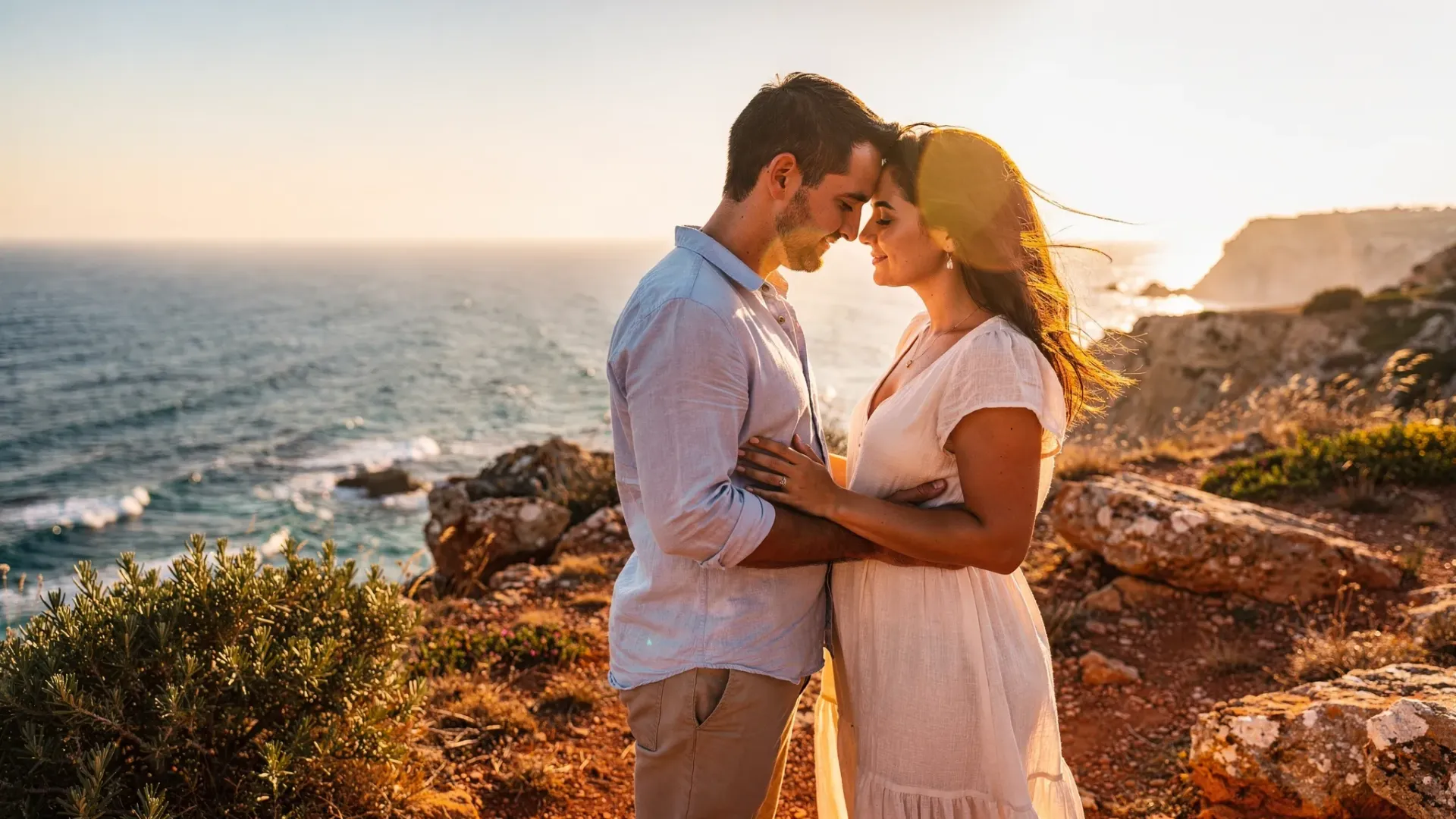
You are somewhere between sleep and waking.
A half-charged phone glows in your hand.
And in that quiet, private place, you can finally admit it.
You do not want a performance. You want a moment.
You want your story told the way it actually feels, soft around the edges, real in the center.
Film-first means the day serves the feeling
A film-first timeline is not “more photo time.”
It is a day designed around light, breath, and the kind of space where you can forget there is a camera at all.
Because the truth is, cinematic elopement films are not built from poses.
They are built from pacing.
A hand that reaches for yours without thinking.
A pause before your vows.
Wind hitting the cliff five minutes before the sun turns the sea into hammered gold.
If you already know Spain is calling you, this is how you answer it with intention.
If you want the bigger picture of what eloping here can look like, start with elopement in Spain, then come back to the timeline.
Your story told in Spain, one light change at a time
Spain is not one backdrop.
It is a collection of moods.
Salt on your lips on the Costa Brava.
Dry heat and pale stone in the south.
Pine resin in the mountains when morning is still cool.
When you plan film-first, you stop asking, “What time do we start?”
You start asking, “When does this place become itself?”
That question changes everything.
It nudges you toward sunrise when the streets are empty.
It gives you permission to rest at midday.
It makes your ceremony feel like it belongs to the landscape instead of fighting it.
And it gives your film what it needs most: a story with room to unfold.
If you are curious about how the cinematic side works (what gets captured, why it hits differently), you will feel at home inside Cinematic Elopement Films.
The Mediterranean rhythm (and why it saves your timeline)
In many parts of Spain, the day has a built-in pause.
The bright hours can be hot, the streets can get busy, and your body naturally wants to slow down.
A film-first timeline listens.
You do something meaningful in the morning.
You disappear for a while.
You come back out when the light softens and the world turns honey-colored again.
This is not wasted time.
This is where the day becomes yours.
A slow lunch.
A shower with the window cracked open.
A nap while your clothes hang like sails.
A few lines of vows rewritten, not because you have to, but because you finally can hear yourself.
A sensory portrait: where the vows feel inevitable
Picture this.
You are above the water, not high enough to feel dramatic, just high enough that the sound of the sea becomes a steady, patient drum.
The path is narrow.
Limestone dust clings to your shoes.
A rosemary bush warms in the sun, and when you brush past it, the scent stays on your fingers.
Down below, the waves keep showing up and pulling back, like breathing.
You do not need an aisle.
You do not need chairs.
You need one honest spot where you can face each other and let the world blur.
This is what location scouting really is.
Not finding “a view.”
Finding the exact place where the wind is calmer, where the echo is gentle, where the light wraps instead of blasts, where you can stand close and mean every word.
A film-first timeline (a sample day that actually feels good)
Every elopement is different.
But film has patterns. So does Spain.
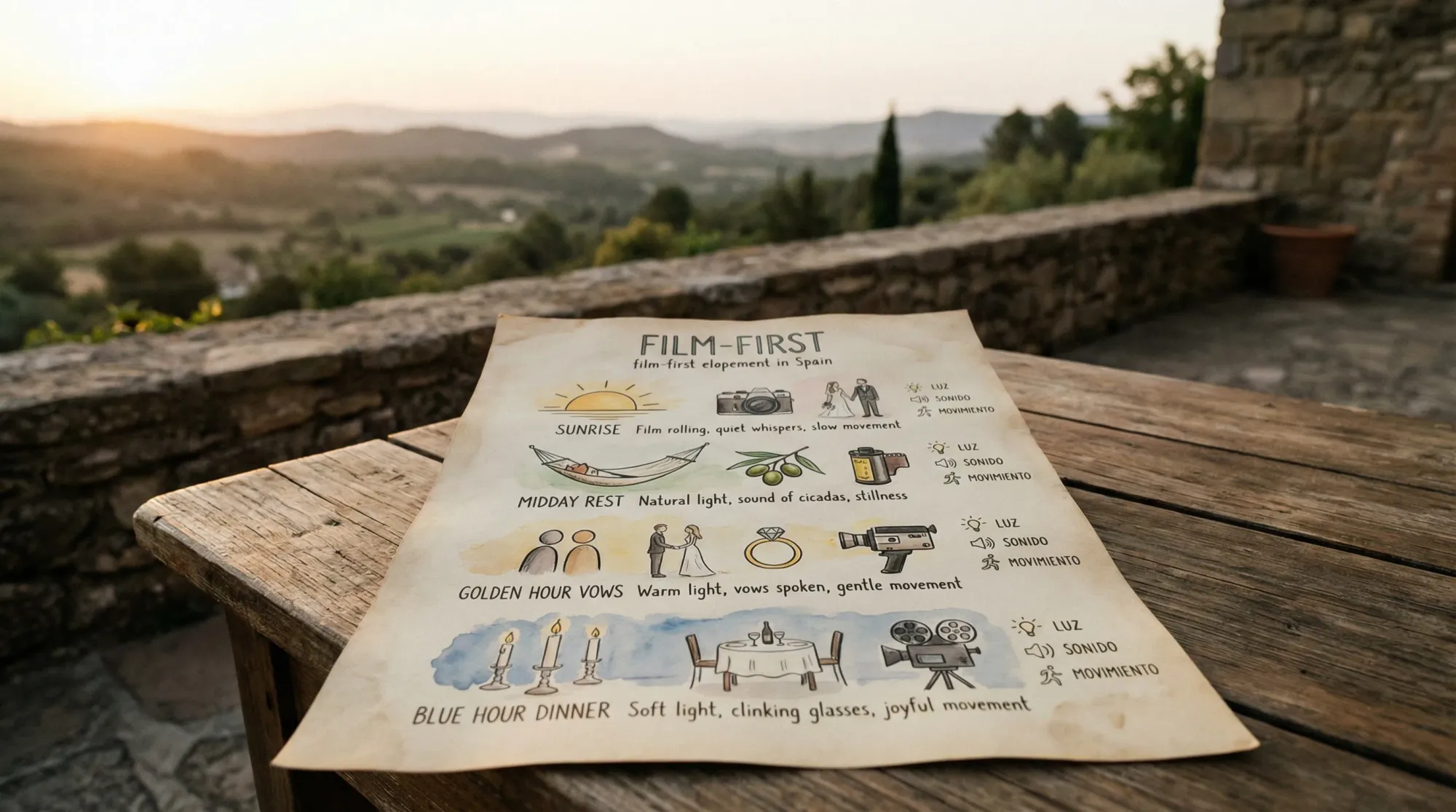
Here is a sample flow you can adapt, especially for coastal or village-based days.
| Time window | What you are doing | What it gives your film |
|---|---|---|
| Sunrise to mid-morning | Quiet start, getting ready slowly, first look, a short walk | Empty spaces, natural sound, calm nervous energy, the “before” chapter |
| Late morning | A gentle adventure (short hike, old town wander, coffee stop) | Movement, candid laughter, the texture of Spain in small moments |
| Midday | Rest, food, hydration, shade (and permission to do nothing) | A reset, so you are present later instead of pushing through |
| Late afternoon | Getting dressed again, vow prep, travel to ceremony spot | Anticipation, details, hands, fabric, breath |
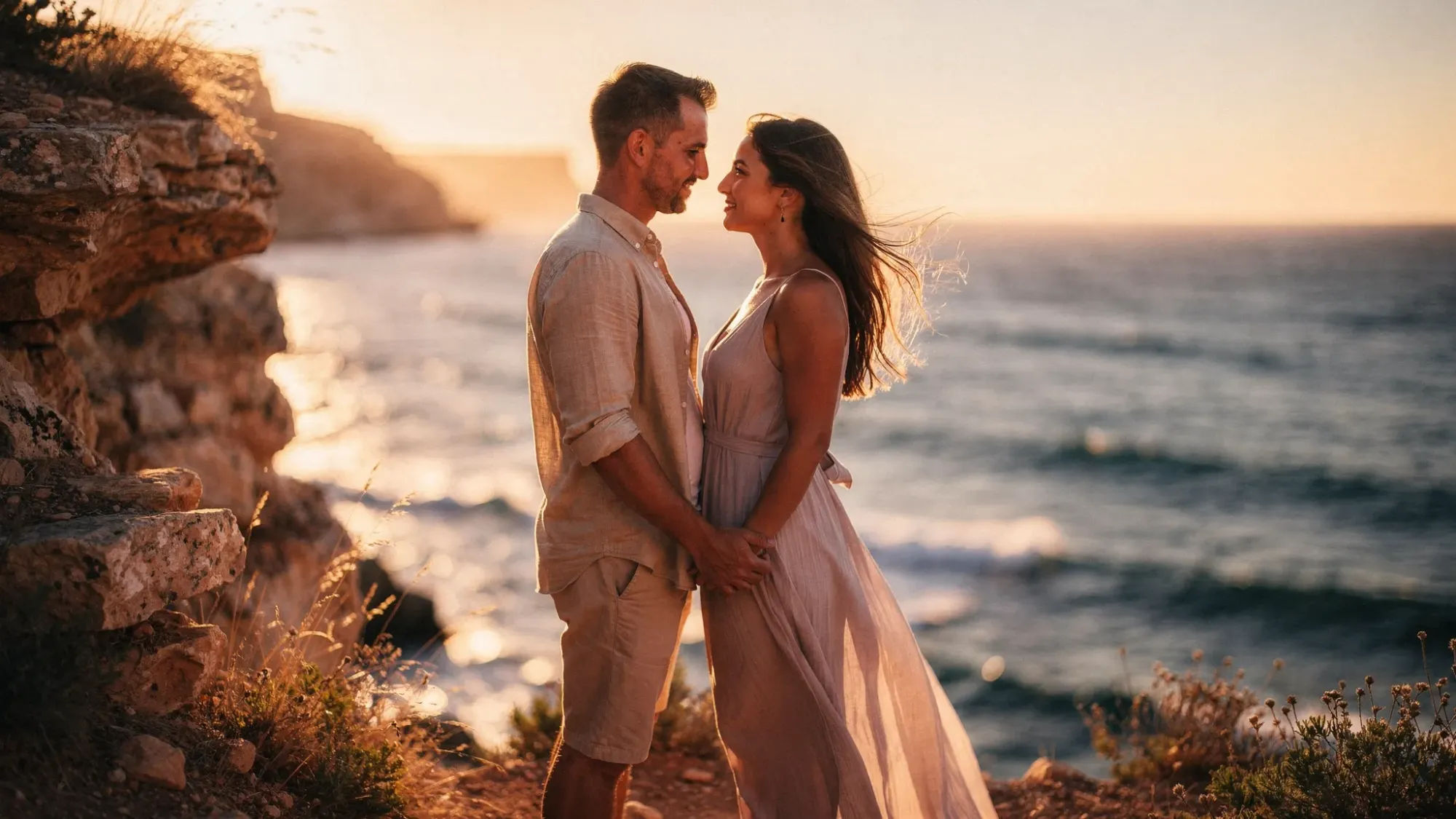
| Golden hour | Ceremony, vows, portraits without posing, just walking and holding each other | Warm light, emotional peak, the heart of your story |
| Blue hour into night | A second location, a quiet toast, a slow dinner | Depth, contrast, city lights or lantern glow, an ending that lingers |
You will notice what is missing.
No frantic vendor hopping.
No squeezing ten locations into one afternoon.
No treating your vows like an item on a checklist.
Instead, the timeline protects the emotional arc.
It lets the day start quiet, build slowly, peak softly, and land warm.
The practical part: how you build a film-first timeline that works
This is the section that makes everything easier.
If you want your day to feel cinematic and calm, focus on these few decisions first.
- Choose your ceremony light before you choose your ceremony time. In Spain, golden hour changes fast. Build the day around when the landscape looks the way you want it to feel.
- Add travel buffers that are actually humane. Small roads, parking, walking paths, and wrong turns are normal. A film-first day includes margin, not because you expect chaos, but because you want peace.
- Plan sound on purpose. Vows are not just words. They are your voices, the sea behind you, the way you swallow when you get emotional. Quiet locations matter. So does wind shelter.
- Decide early if it is legal or symbolic. The paperwork path can shape the schedule. A symbolic ceremony gives you the most freedom with time and place. If you are sorting that out now, How to Elope in Spain will help you orient quickly.
- Make one simple weather backup. Not a “second full plan,” just a sheltered alternative nearby (a pine grove, a covered terrace, a quiet street, a villa corner) so you do not lose the feeling if the sky changes.
And then you come back to the dream.
Because the timeline is not the point.
It is the frame that holds the point.
When you bring guests (without turning it into a production)
Sometimes you want a few people there.
A sibling who knows every version of you.
A parent who feels like home.
Two friends who will cry quietly and never make it about themselves.
A film-first timeline can hold that, as long as the circle stays small and the expectations stay gentle.
One trick I love for guest participation is giving them a way to capture their own imperfect little pieces of the day, without turning it into phones-in-faces all afternoon.
Something like Revel.cam’s instant event photo sharing can work beautifully for this. Guests scan a QR code, snap a limited number of photos, and you end up with a shared gallery of the day from the angles you did not even see.
Your film holds the story.
Their photos hold the whispers around the edges.
The small choices that make your film feel like you
Cinematic is not a filter.
It is decisions.
It is choosing the ceremony spot because it feels true, not because it is famous.
It is letting the morning be quiet.
It is wearing something you can move in.
It is eating when you are hungry.
It is not forcing tears, not forcing smiles, not forcing anything.
When you build a timeline this way, you stop “performing a day.”
You start living inside it.
And that is the only way your story told can feel honest on screen.
Frequently Asked Questions
Do I need sunrise for a film-first timeline in Spain? No. Sunrise is beautiful for quiet and privacy, but a film-first day is really about choosing the best light for your location and protecting your energy.
How long should vows take in a film-first ceremony? Long enough to land. For most couples, 5 to 10 minutes each feels spacious without drifting. The bigger goal is choosing a place where you can speak without fighting wind and noise.
What if we want multiple locations? Two locations is usually the sweet spot (one for intimacy, one for variety). More than that can start to feel like a travel day, not a story.
Can a film-first timeline still include adventure, like hiking or a boat? Yes. The trick is matching the adventure level to your timeline, and building in recovery time so you are not exhausted when the emotional moments arrive.
Should we do legal paperwork on the same day as the ceremony? Sometimes it is possible, but many couples prefer separating the legal steps from the vow experience. It keeps the elopement day pure and unhurried.
A quiet invitation
If you are reading this and feeling that ache in your chest, the one that says, this is what we want, listen to it.
Wanting something different is not dramatic.
It is honest.
And Spain is full of places where the light does something so gentle, it feels like permission.
Dominick is not here to sell you a template. He is here to scout the cliffs, read the wind, shape the hours, and make sure your story told in Spain feels like you lived it, not like you survived it.
When you are ready, you can reach out through Stories by DJ’s elopement planning services.
A free discovery call is just a conversation between dreamers.
You bring the feeling.
Dominick brings the map, and the light.
Previous Article
Spain Elopement Packages For Two, Intimate & Cinematic Films

I'm Dominick let's craft your perfect Mediterranean elopement.
Let's create a day that captures your love, surrounded by the Mediterranean's beauty. Ready to plan your perfect escape?
Start your Adventure Let's talk!