What if you just ran away and eloped? The case for choosing each other over everything else..
It's late.
The house is quiet. The phone is face-down on the nightstand. And somewhere between the silence and the ceiling, a thought keeps surfacing —
What if we just ran away?
Not away from each other. Away from the spreadsheets and the seating charts. Away from the venue deposit that hasn't been paid. Away from the relative who already has opinions about the flowers. Away from the version of your wedding day that seems to belong to everyone except you.
You've been engaged for — what, six months? Eight? Long enough to know what a traditional wedding costs, both financially and emotionally. Long enough to have had the conversation. The one where one of you said it quietly, half-joking but not really:
"What if we just... didn't do all of this?"
This article is for that moment. For that thought. For the version of your love story that doesn't need an audience to be real.
The number you already know
The average wedding in the United States now costs $35,000–$36,000. In Europe, the figure is comparable — often higher ($50,000+) once you factor in the venue, the catering, the flowers, the DJ, and the photography. A national survey of over 1,000 engaged couples found that 62% of them were open to considering a scaled-back elopement-style wedding — and that number climbed to 69% among women. More quietly devastating: 60% of already-married survey participants from all age demographics said they wished they had eloped.
Read that again.
Six in ten married people — people who have already had their wedding — wish they had done it differently.
That is not a fringe sentiment. That is a majority. And it says something profound about the gap between what a wedding is supposed to feel like and what it actually does.
65% of couples who elope say they felt more authentic and true to themselves during the ceremony, and 48% say they felt more genuinely emotionally connected during a small ceremony compared to large weddings.
There is something happening here. Something worth paying attention to.
A Brief, Honest History of Why Weddings Became What They Are
Here is what nobody tells you: the elaborate, expensive, performance-based wedding is not a tradition in any ancient sense. It is a relatively recent invention — and it was never designed with your love story in mind.
The precise origins of marriage date back to around 2350 BC in ancient Mesopotamia. In ancient societies, marriages served economic, political, and social purposes — they united extended families, allowed inheritance rights, and ensured the legitimacy of children. Love, if it was present at all, was incidental.
The ceremony itself — in its earliest forms — was strikingly simple. Pre-Christian Roman marriages generally did not happen in churches or temples, nor were they presided over by priests. Someone usually presided over a wedding, but anyone who was socially prominent could do it. The earliest requirement was little more than a public statement of intention — witnessed by people who mattered to the couple.
The Church's involvement came later. Much later. For much of the early Christian Era, the Church stayed out of weddings and let the state handle the union of man and woman. Only after 800 AD did the Church begin to perform weddings, and a few centuries later the Catholic Church made marriage one of the sacraments.
And as for the elaborate spectacle of it all — the hundreds of guests, the multi-course dinner, the white dress, the floral arrangements that cost more than a semester of university — those belong firmly to the 19th and 20th centuries. They were shaped not by love, but by commerce. By the rising wedding industry. By the Victorian insistence on visible wealth as social proof. By a culture that slowly, quietly handed couples a script and told them this was the only way to mean it.
For the upper classes, an ostentatious wedding was another way to demonstrate one's wealth and power, cement alliances between families, and to trade wealth via dowries.
You are not a dowry negotiation.
You are two people in love, in 2026, and you get to decide what your commitment looks like.
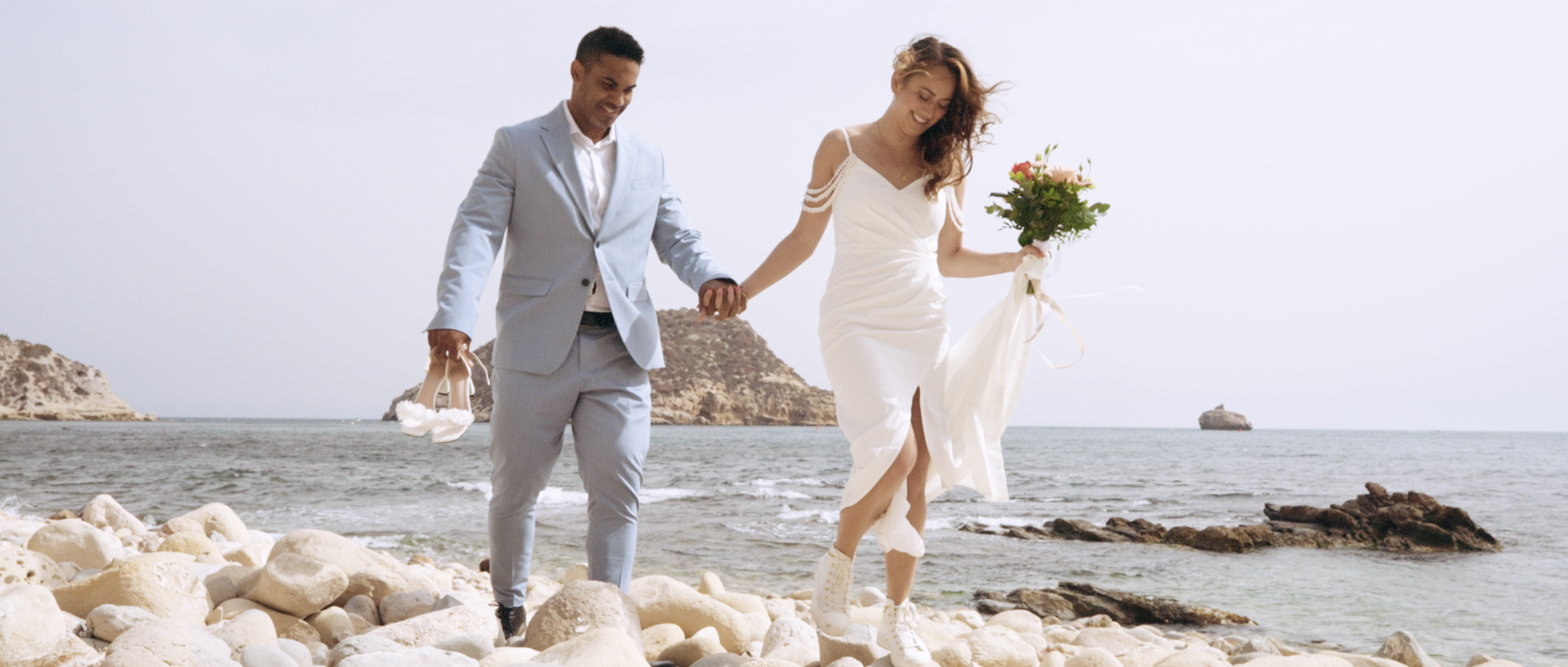
What is actually ancient — what is truly, deeply human — is the simpler thing. A promise. Witnessed by the earth itself. By the wind and the light and the landscape that holds you.
That is not modern. That is primal. That is returning to something.
The Freedom Paradox: Why Less Choice Creates More Meaning
There is a concept in psychology known as the paradox of choice — the idea that too many options do not liberate us but paralyze us. The research behind it, pioneered by psychologist Barry Schwartz, shows that the more decisions we have to make, the less satisfied we tend to be with the outcome. We second-guess. We regret. We wonder if we chose wrong.
A traditional wedding is, essentially, an exercise in infinite choice. The venue. The caterer. The florist. The band. The seating chart. The favors. The timeline. The dress code. The invitation wording. The cake flavor. The honeymoon.
Every one of these decisions carries weight. Every one requires negotiation — with each other, with your families, with the expectations of people who have never once had to live inside your relationship.
And here is the thing no one says clearly enough: by the time you walk down that aisle, you have made ten thousand small concessions to other people's comfort. The guest list includes people you barely know. The venue was chosen partly because it would make someone else happy. The timeline has been adjusted around other people's travel schedules.
Whose day is it?
An elopement answers that question immediately.
When you strip away the performance, you are left with the only thing that was ever actually yours: the two of you, your vows, and a place in the world that holds your energy. The most reported reason why couples choose to elope is a rejection of the big traditional wedding — couples who elope desire a wedding that looks and feels like them instead of a cookie-cutter celebration that follows societal norms.
Freedom does something to people.
It creates presence. It creates energy. It creates the conditions for a moment you can actually feel.
There is a reason that elopement couples consistently describe their day as more emotionally vivid, more connected, more real than couples who went the traditional route. It is not because elopements are inherently superior. It is because when you remove the noise, you can finally hear the signal.
What You Actually Fear (And Why It Doesn't Mean What You Think)
You might be reading this nodding along, and then something tightens in your chest.
But what about my mum? What about our friends who are expecting to be there? Is it selfish? Will people feel hurt?
These are real feelings. They deserve real honesty.
The fear of disappointing people is legitimate. But it's worth examining whose story that fear belongs to. Because the feeling of not wanting to hurt anyone — while beautiful in its care — is often the same force that turns a wedding into something designed for everyone except the people getting married.
A common phrase many couples use is that they wanted a "just us" wedding day — one that was not about anyone else's expectations but about their own intention and presence.
And as for the people who love you — the ones who genuinely, deeply love you — they want you to be happy far more than they want to witness a performance. Most people, when they understand that an elopement was a deeply intentional, joyful, meaningful choice, are not hurt. They are moved.
You can celebrate with them after. You can share the film with them. You can host a dinner, a party, a gathering. But the moment of actually promising each other — that can be yours.
There is a difference between excluding people from a celebration and choosing to make a sacred moment private.
One is selfish. The other is honest.
The Rise of the Intentional Elopement
Something has shifted in recent years, and it is worth naming.
The elopement is no longer what it once was. It is no longer the hushed courthouse ceremony, the Vegas chapel at midnight, the thing you did because you had to rather than because you chose to. Modern couples view elopements as a conscious choice to create a meaningful experience without the grandeur and pressures of a large wedding — a way to prioritize intimacy, financial sense, and personal expression.
A massive 91% of millennials said they would seriously consider elopement when planning their wedding.
This is a cultural shift. A generational rejection of the performance in favor of the presence. A collective realization that meaning is not found in scale — that a hundred guests do not make a vow more true, that an expensive venue does not make a promise more permanent.
The use of social media hashtags related to elopements has increased by over 150% since 2019, indicating growing popularity and community sharing.
What is emerging is something entirely its own — something more like a ceremony in the original, ancient sense. Two people. A landscape that holds them. Vows that belong to no one else. A film that captures not a performance, but a life.
This is the intentional elopement.
And it is not a compromise. It is an upgrade.
Why Location Changes Everything
Here is something Dominick has observed after more than a decade filming elopements across Spain and the Mediterranean: the location is not a backdrop.
It is a participant.
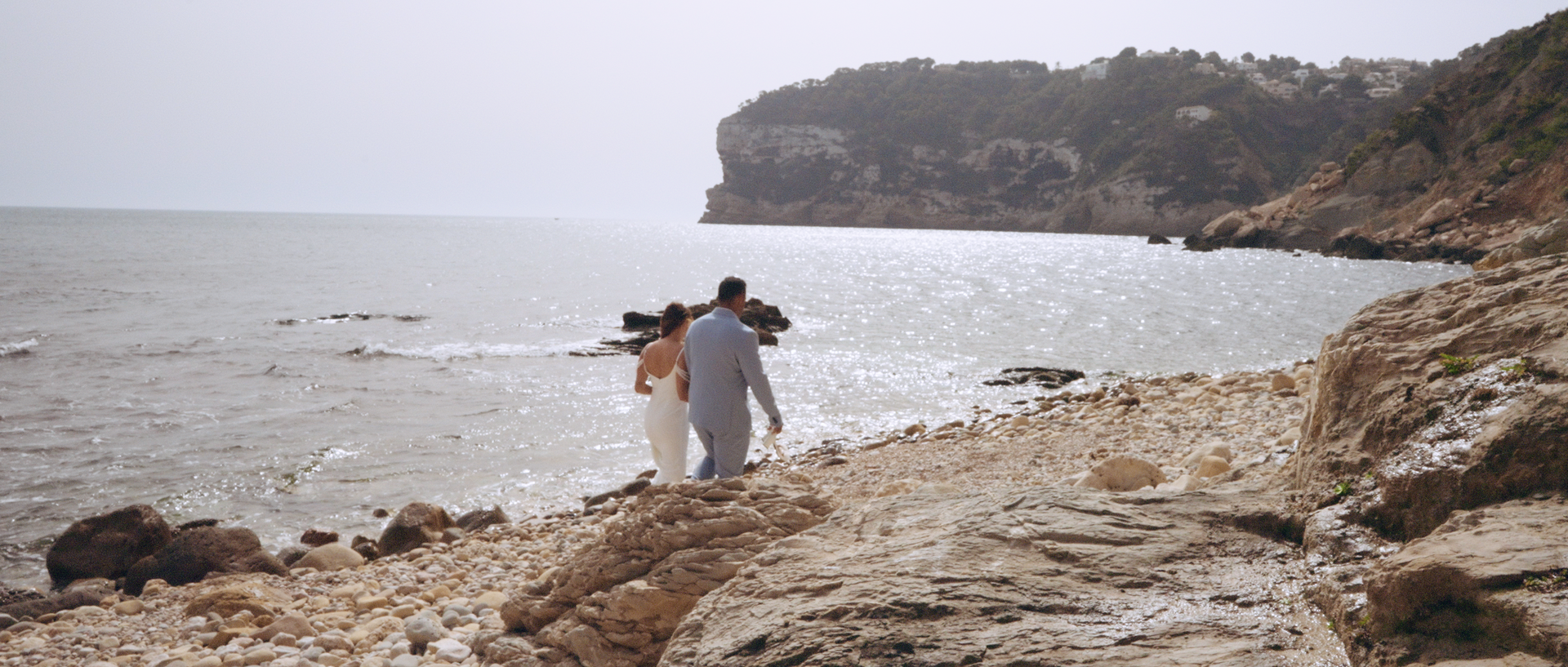
When you stand on an undiscovered cliff above the Mediterranean at golden hour — the kind of place that doesn't appear on Pinterest because not many people know it exists — something happens to the body. The shoulders drop. The breath slows. The mind goes quiet. You stop thinking about what you're supposed to say and you start feeling what is true.
That shift — from performance to presence — cannot be manufactured in a banquet hall. It requires space. It requires silence. It requires a landscape large enough to hold the full weight of what you're doing.
The ancient instinct toward nature in moments of deep significance is not accidental. Humans have always made their most important promises in the open air — at rivers, on mountains, under trees that were older than anyone alive. The church interior came later. The venue came much later. The cathedral of the natural world came first.
Spain understands this in a way that few places do.
An olive grove at sunrise in Alicante smells like something before language. The light on the Costa Brava in September moves like it is alive. A hidden waterfall in the Spanish hills makes silence into sound. These are not aesthetics. They are conditions for truth.
There are places in Spain where Dominick has stood — locations he has physically scouted, places he has returned to across seasons — that nobody has photographed for a wedding. Where the path is unmarked. Where the tourists have not yet arrived. Where the light does something at a particular hour that makes you feel briefly, impossibly awake.
Those are the places where couples exhale.
Those are the places where the ceremony stops being something you're doing and becomes something you're inside of.
If you want to read about what some of those places look and feel like, explore the location inspiration here.
What an Elopement in Spain Actually Looks Like
One of the most common fears about eloping is that it will feel sparse. That it will feel like settling. That it will feel like you skipped something.
Let's describe what it actually looks like when it's done with intention.
You wake up early — earlier than you've been awake in months. The sun is not yet fully up. You dress in something that makes you feel like yourself, not like a costume. There is no coordinator knocking on your door with a timeline. There is no makeup artist running late.
There is just the two of you, and a morning that belongs entirely to you.
Dominick picks you up — or meets you at the trailhead, or on the dock, or at the edge of the olive grove. He has already been there. He knows where the light will fall. He knows when the wind shifts. He has walked this ground before so that you don't have to think about anything except each other.
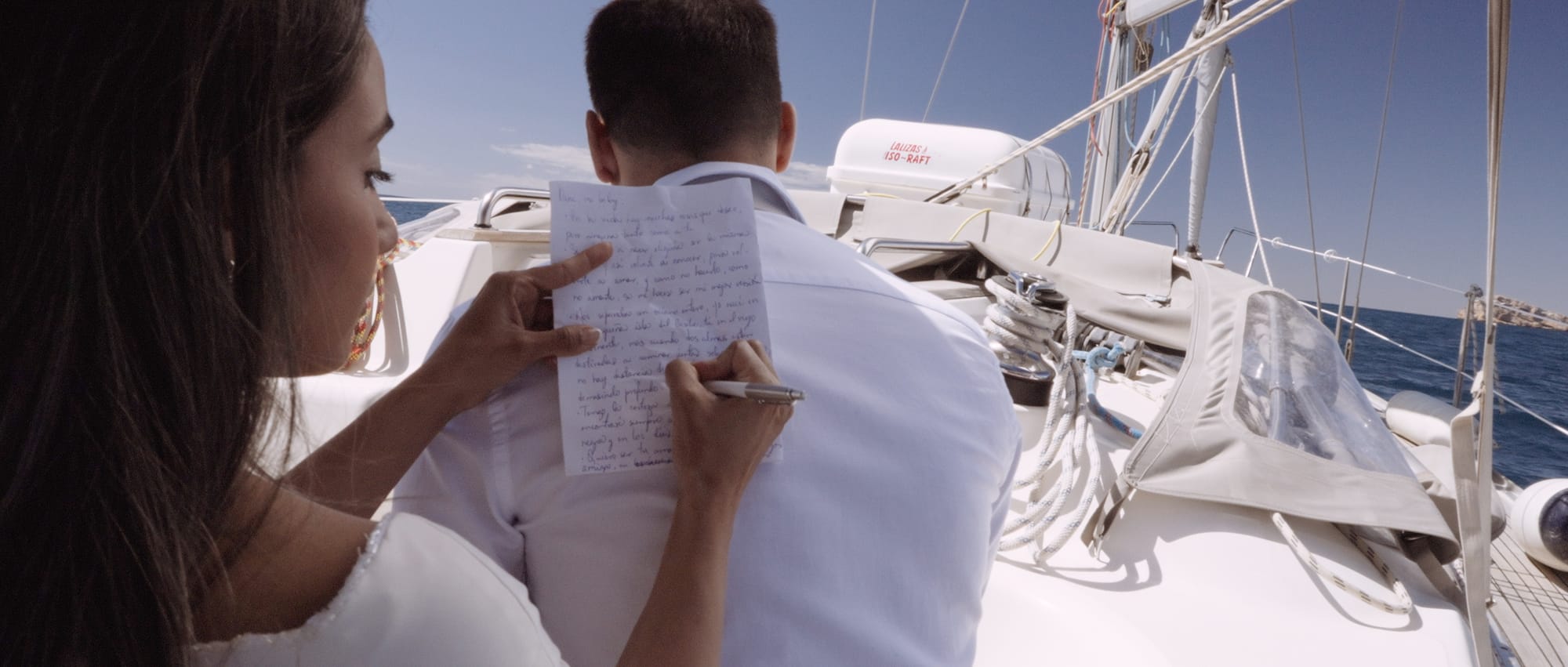
The ceremony is what you make it. You might have written vows. You might have a few words from someone who loves you both. You might stand in silence for a long moment and let the landscape be the only witness you need. There are no speeches from people who aren't there. There is no DJ transition. There is no anxious awareness of a hundred people watching your face.
There is just the fact of it.
The fact of your love, and your choice, and this place, and this light.
And then Dominick captures it — not as a performance, but as a document of something real. A cinematic film that gives you back not just images, but the feeling of that morning. The way the air moved. The way you looked at each other when you thought no one was watching. Except someone was. And they were filming it like it was exactly what it was: the beginning of everything.
This is what a Spain elopement can be when it is designed with care.
The Practical Reality (Because Dreams Still Need Foundations)
Let's talk logistics — briefly, because they matter, but they should never be the reason a dream doesn't happen.
On legality: Many international couples choose to complete their legal marriage paperwork in their home country and then hold a deeply personal symbolic ceremony in Spain. This is common, fully valid, and gives you the best of both worlds — legal security and a ceremony that is entirely yours in design. You can read more about how to handle the legal side here.
On cost: The average cost of an elopement is a fraction of a traditional wedding. The average cost of a wedding in 2024 was $33,000. A fully planned, fully filmed elopement in Spain — including location scouting, ceremony design, and cinematic film — can be done for a figure that leaves you with money for a honeymoon that actually means something. You can find out what an elopement in Spain costs here.
On timing: Spring and autumn are ideal in Spain — April through June and September through October offer golden light, mild temperatures, and far fewer tourists. Sunrise ceremonies in summer are also extraordinary. There is almost no wrong time to elope in Spain if you know the land well enough to work with it.
On what you need: You need each other. You need a guide who knows what they're doing. You need a location that holds your energy. Everything else is optional. There is no minimum guest count. There is no required vendor team. There is no dress code except whatever makes you feel like yourselves.
If you want to understand what full-service planning and filmmaking looks like together — why having one person who thinks like both a planner and a filmmaker changes everything — read more about what working with an elopement planner in Spain actually involves.
On Being Remembered
There is a moment in every elopement film that Dominick has made — a moment that doesn't appear in traditional wedding footage.
It is the moment after the ceremony, when the formal part is done, when no one is waiting for anything, when the couple looks at each other and realizes: we actually did it.
It is not the first kiss. It is not the ring exchange. It is the moment after all of that, when the weight of expectation lifts and what's left is just two people on a cliff in Spain, laughing or crying or both, the Mediterranean below them, the light doing something unrepeatable with the air.
That moment cannot be staged. It cannot be directed. It happens when you have given two people enough freedom, enough space, and enough trust that the real thing can surface.
That is what a cinematic elopement film captures.
Not the performance of a wedding. The experience of one.
You will watch it on your anniversary. You will show it to people you love. You will watch it on a difficult day and remember what you chose and why.
"We are eloping because we appreciate a more intimate setting, making the day about us, having an adventure and an experience to remember."
That is not selfish. That is exactly right.
If you're curious what these films actually look like — what it means when a filmmaker designs your day around emotion rather than schedule — you can explore real elopement films here.
And If You're Still Just Dreaming
You might not be ready.
You might be reading this at midnight, still in the middle of the planning, still trying to make everyone happy. You might be months away from knowing what you actually want.
That's okay.
The dream is the beginning.
The couples who end up with the most meaningful elopements are almost always the ones who spent time in this space — the late-night wondering, the quiet "what if," the slow realization that the thing they wanted was always simpler than what they were planning.
Dominick loves those early conversations. The ones where a couple is still figuring it out. Where they say "we think we want something small and real, somewhere wild, somewhere no one has photographed before" and he gets to lean in and say: I know exactly the place.
That conversation — the one where you just talk about what you actually want, no pressure, no commitment, no vendor pitch — is called a free discovery call. It is a conversation between dreamers. It takes thirty minutes and it might change how you see the whole thing.
If that sounds like something you need right now, you can reach out and plan that call here.
Your dream is not too big. It is not too small. It just needs the right landscape, the right light, and someone who knows how to hold space for it.
Spain is waiting.
Your story is ready.
Dominick is an award-winning filmmaker and elopement planner based in Spain, specializing in authentic, intimate elopements on undiscovered locations across the Mediterranean. He designs each day around light, emotion, and the specific energy of each couple — then captures it in cinematic film.
Previous Article
How to Elope in Spain: Step-by-Step Guide for Adventurous Couples

I'm Dominick let's craft your perfect Mediterranean elopement.
Let's create a day that captures your love, surrounded by the Mediterranean's beauty. Ready to plan your perfect escape?
Start your Adventure Let's talk!