Vineyard Elopement Priorat: Vows Among Vines and Slate
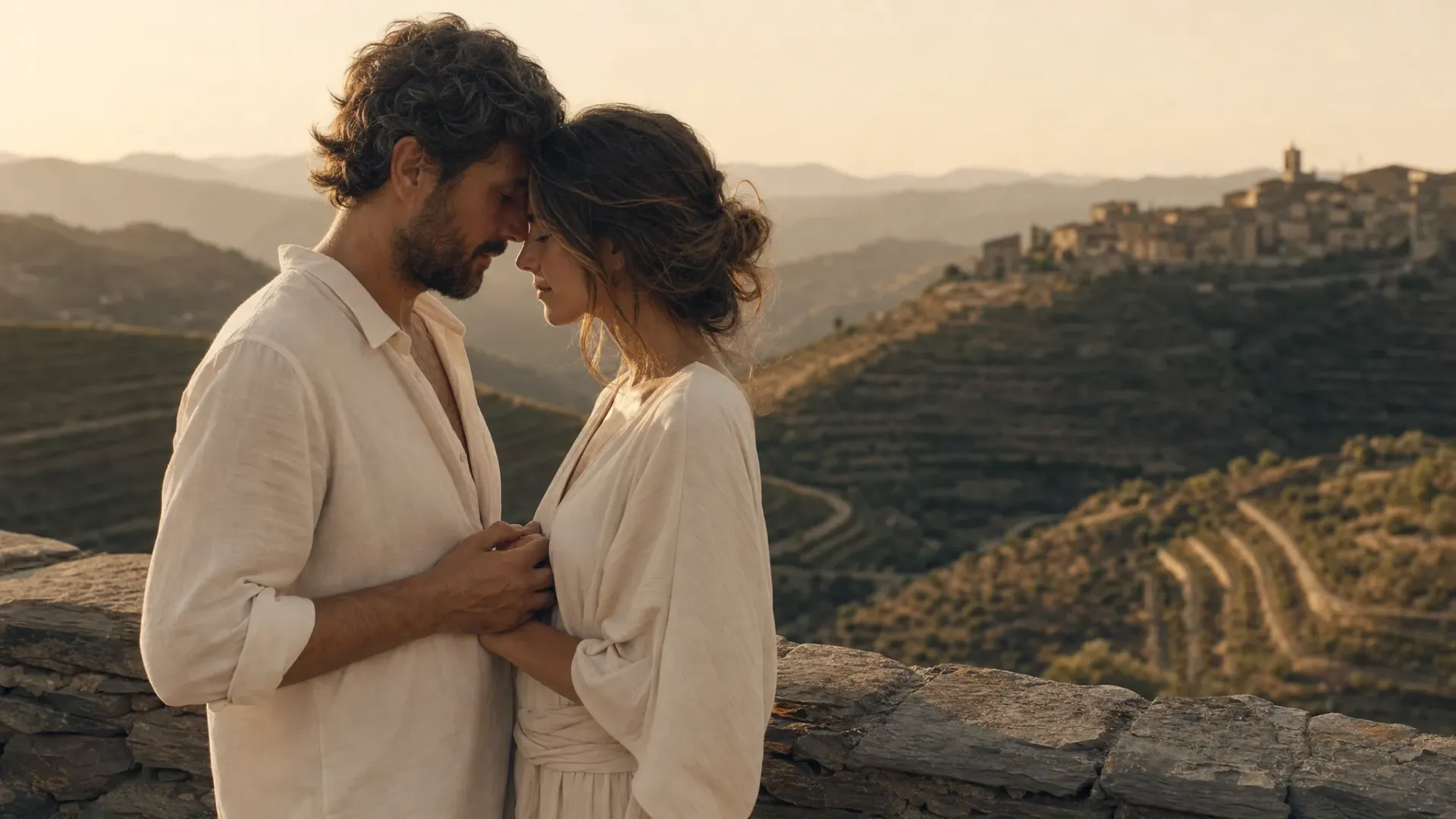
You can feel it before you explain it.
The old version of a wedding feels too loud in your hands.
You want somewhere quieter. Somewhere the earth has texture. Somewhere your vows do not have to perform for anyone.
That is why a vineyard elopement Priorat can feel less like choosing a place and more like recognizing one.
The vines are not decoration here. They are lines written into the hills.
The slate is not a backdrop. It is the reason the land holds heat after sunset.
And you are not trying to make a wedding look beautiful. You are trying to make a promise feel honest.
Vineyard elopement Priorat: vines, slate, and a kind of silence you can stand inside
Priorat sits in Catalonia, inland from Tarragona, where the roads begin to curl and the hills fold into themselves.
It is not a soft vineyard landscape in the polished sense.
It is wilder than that.
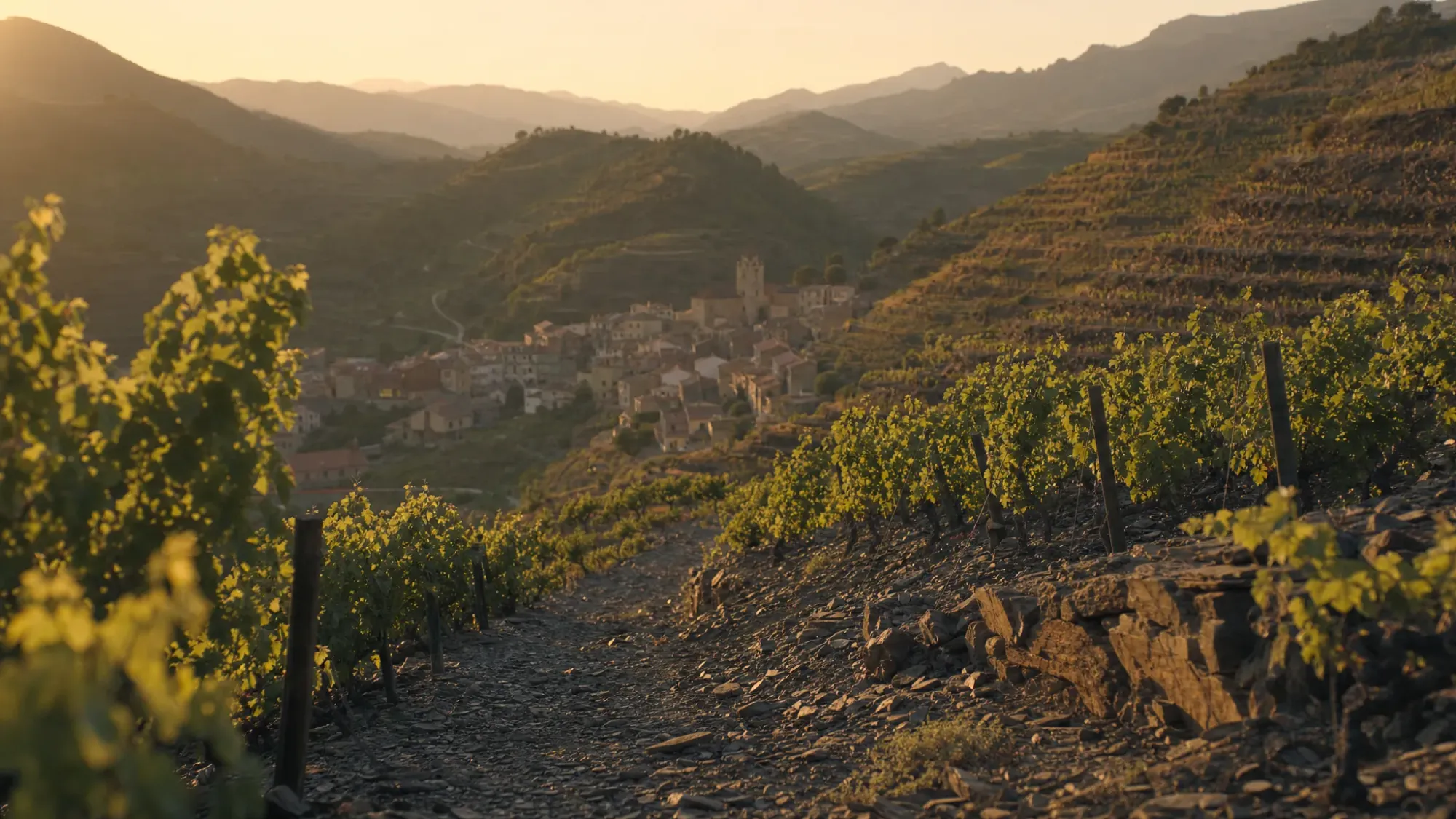
Terraces climb at impossible angles. Stone villages sit close to the earth. Olive trees lean into the dry wind. The famous dark slate soil, called llicorella, breaks underfoot in thin, mineral pieces that catch the light like old glass.
This is part of what gives DOQ Priorat its depth as a wine region. But for your elopement, it gives something else.
A feeling of being held by land that has survived heat, patience, and time.
You do not come here for a manicured aisle.
You come here for a vineyard track at golden hour, for the sound of gravel under your shoes, for a ceremony where the wind moves through vine leaves before you say the first word.
Priorat suits you if you are not looking for spectacle.
It suits you if you want the landscape to be part of the vow, not just the scene around it.
The places where your vows start to breathe
Imagine arriving near Gratallops as the afternoon lowers itself into the terraces.
The village is quiet in that old Mediterranean way, shutters half open, stone warmed by the sun, a cat asleep near a doorway. Beyond it, the vineyards fall and rise in rows that do not feel arranged so much as carved.
Near Porrera, the hills feel more intimate. Narrow roads bend between vineyards and old masías. You hear bells somewhere in the distance, then nothing but insects and the dry scrape of the wind.
Around Poboleda, the light softens earlier. The vines catch it leaf by leaf. If you stand still long enough, the whole valley seems to exhale.
And then there is Siurana, not a vineyard ceremony in the strictest sense, but close enough to belong in the same dream. Cliffs. Reservoir blue far below. The kind of horizon that makes you speak more slowly.
A Priorat elopement can begin among vines and end on stone. Or begin in a village lane and close with dinner beneath a pergola while the hills go purple.
Nothing has to be crowded into the day.
The point is not to do more.
The point is to feel more of what is already there.
The hour matters as much as the place
In Priorat, light is not just light.
It changes the feeling of the land completely.
Midday can be bright and hard, especially in summer. The slate reflects heat. The vines look sharp and green. Everything asks you to slow down.
But early morning has tenderness.
The air still holds a little coolness. The villages are waking. A ceremony before the day fully opens can feel almost secret, especially if you want the rest of the world to stay far away.
Late afternoon is the more cinematic hour.
The hills begin to bronze. Shadows settle between the vine rows. Skin tones soften. The land gives back the sun it has held all day.
If you are comparing vineyard seasons across Spain and France, Dominick has written more deeply about the best time of year for a vineyard elopement in Spain or France. For Priorat specifically, these rhythms matter.
| Season | What Priorat gives you | What to plan around |
|---|---|---|
| Spring | Fresh vine growth, wildflowers, cooler walking weather | Occasional rain and softer ground on rural tracks |
| Early summer | Long evenings, warm dinners outside, full green vines | Heat during midday and stronger sun exposure |
| Late summer | Golden dryness, deep color, quieter mornings | High temperatures and limited shade in exposed vineyards |
| Harvest season | Energy in the villages, ripe grapes, rich atmosphere | Vineyard access may be restricted because estates are working |
| Winter | Bare vines, slate texture, intimate village stillness | Shorter days and cooler evenings, especially after sunset |
Late April to early June often gives you softness.
Late September into October gives you depth.
But harvest is not just a pretty word here. It is real work. Estates may be busy. Access to certain rows may be limited. The land is alive with its own schedule, and the most respectful elopement is the one that listens.
That listening is part of the beauty.
You are not imposing your ceremony on the place.
You are finding the place that can receive it.
What a Priorat vineyard elopement needs in real life
The dream can stay poetic.
The planning still needs to be grounded.
A vineyard elopement in Priorat usually works best when it is designed with patience, permissions, and a realistic sense of the terrain. The most beautiful plan is often the simplest one, especially here.
Keep these things close as you begin imagining it:
- Private vineyard permission: If you want to stand among actual vine rows, you need approval from the estate or landowner, especially during growing and harvest periods.
- Access and terrain: Many vineyards sit on steep slopes with slate underfoot, so shoes, dress movement, and walking distance matter more than they would in a flat venue.
- Ceremony type: Many international couples choose a symbolic ceremony in Spain, then complete legal paperwork at home or through the appropriate civil process for their situation.
- Time of day: Sunrise and late afternoon usually feel better than midday, both for comfort and for film.
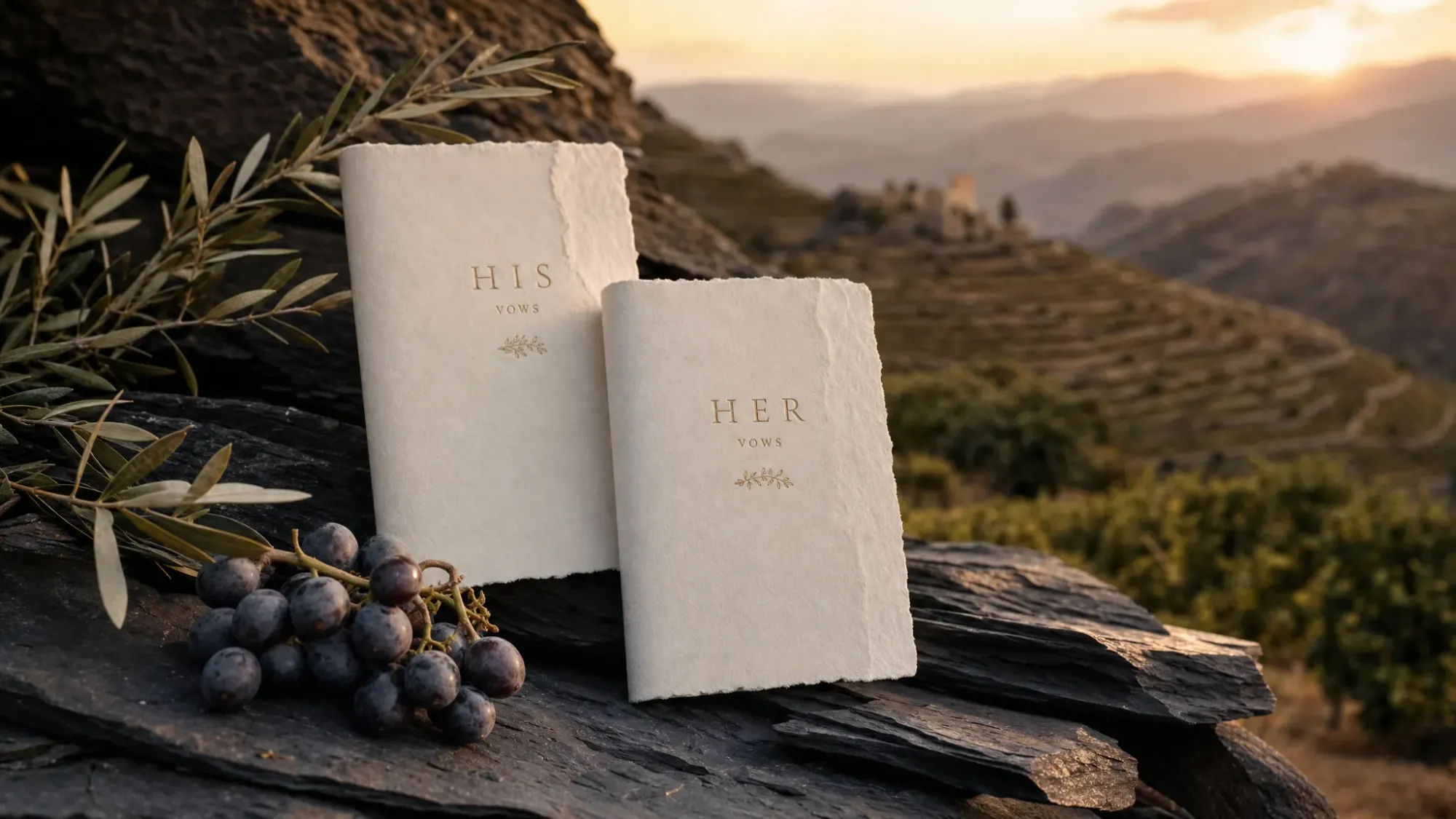
- Wind and sound: Small vow books, discreet microphones, and a protected ceremony spot help your words stay present in open landscapes.
- Drone considerations: Drone filming in Spain must follow AESA rules, privacy laws, airspace limits, and local restrictions, so it should never be assumed without checking first.
This is where a guide matters.
Not someone arriving with a clipboard and a fixed template.
Someone who understands that a beautiful elopement can fall apart if the walk is too steep, if the sun is in your eyes, if the vineyard is harvesting that morning, if the road is too narrow for the timing you imagined.
Dominick’s work lives in that space between feeling and logistics.
He helps you shape the ceremony, scout hidden places, build the rhythm of the day, and keep the experience small enough that it still feels like yours. The film is not a separate layer placed on top afterward. It is part of how the day is designed from the beginning.
You do not need a large team moving around you.
You need the right person paying attention.
A day that moves like breath
Your morning does not have to start with noise.
It can start with coffee near a window in Falset, the kind of morning where you speak softly because nothing needs to be rushed.
Maybe you get ready separately for a little while. Maybe you help each other with the last details, fingers on linen, a clasp at the back of a dress, dust on leather shoes before the ceremony even begins.
In the afternoon, you drive into the hills.
The road narrows. The village drops behind you. The vineyard appears slowly, first as green lines, then as a whole amphitheater of vines and slate.
You walk to the ceremony spot together or meet there in silence.
No aisle. No audience. No performance.
Just breath.
Just the land.
Just the person you choose.
After vows, there is time to stay. That part matters. You do not have to leave the moment the words are finished.
You can sit on a stone wall. Open a bottle from the place that held you. Let the first few minutes of marriage be unproduced and unannounced.
Later, the day can move toward portraits in a village lane, a cliff edge near Siurana, or a candlelit table where dinner arrives slowly and the night smells faintly of rosemary, dust, and wine.
The ceremony can belong to the land
A symbolic ceremony in Priorat does not need to be elaborate.
Actually, it is usually stronger when it is not.
You might place a small piece of llicorella on the ceremony table, not as a prop, but as a tactile reminder of where the vow is made. You might share a quiet sip of local wine after speaking, not as a performance, but as a way of tasting the land together.
You might carry olive leaves, not a large floral arrangement. You might stand without chairs, without an arch, without anything that tries to compete with the rows behind you.
Your vows can be short.
They can tremble.
They can include the private language only the two of you understand.
If writing them feels too large, this guide to writing elopement vows for Spain weddings can help you find a shape without making your words feel scripted.
The best vows here sound like they have room around them.
A sentence.
A pause.
Wind through leaves.
Another sentence.
You do not have to fill the silence.
Priorat gives you silence that knows what to do.
What makes Priorat different from other vineyard elopements
There are vineyard landscapes that feel romantic because they are soft.
Priorat is romantic because it is honest.
It has edges.
The slopes are steep. The soil is dark. The villages do not dress themselves up for you. In summer, the heat asks for humility. In winter, the bare vines show their structure.
That honesty is why the region works so beautifully for couples who do not want to pretend.
If you have felt strange inside traditional wedding conversations, seating charts, timelines built around other people’s expectations, a place like this can feel like relief.
Priorat does not ask you to become louder.
It asks you to become more present.
And because the landscape is already layered, your elopement film does not need manufactured drama. The movement is already there: hands brushing vines as you walk, the shift from road dust to terrace stone, the way the sky changes between the last vow and the first glass of wine.
The film can become what it should be.
A memory with breath in it.
Little details that make the day feel cared for
The smallest choices often change everything.
A ceremony spot with shade nearby. A backup terrace if the wind turns. Water waiting in the car. A dinner reservation that does not make you hurry after sunset. A route that leaves space for stopping when the light does something unexpected.
You may want a vineyard estate as the center of the day.
Or you may want Priorat to feel more like a journey: getting ready in a stone village, vows among vines, portraits near cliffs, dinner somewhere candlelit and quiet.
Both can work.
What matters is that the day has a rhythm your nervous system can trust.
You should never feel like you are being moved from scene to scene for the sake of a schedule.
You should feel guided.
Gently. Clearly. With enough structure that you can let go.
Frequently Asked Questions
Is Priorat a good place for a vineyard elopement? Yes. Priorat is especially beautiful if you want a vineyard elopement with texture, intimacy, and a less polished feeling. Its terraced vines, slate soil, stone villages, and quiet roads make it ideal for couples who want something cinematic but deeply grounded.
When is the best time for a vineyard elopement in Priorat? Spring and autumn are often the most comfortable and atmospheric. Late April to early June brings fresh growth and gentler weather. Late September and October bring golden tones and harvest energy, though vineyard access may be more limited.
Can international couples legally get married in Priorat? It depends on nationality, residency, and the legal route you choose. Many international couples keep the Spain ceremony symbolic and complete the legal paperwork at home. You should confirm requirements with the relevant authorities before making legal plans.
Do you need permission to elope in a Priorat vineyard? Usually, yes. Vineyards are working agricultural spaces and often private property. Permission from the estate or landowner is important, especially during harvest or when filming is involved.
Can you have guests at a Priorat vineyard elopement? Yes, but Priorat often feels best with just the two of you or a very small circle. Terrain, estate rules, parking, and the intimacy of the ceremony spot all affect what makes sense.
Do you need a separate photographer? Not always. Dominick creates a cinematic elopement film and can provide beautiful still frames from the footage. If you want a separate photography approach as well, that can be discussed, but the heart of the experience stays small and intentional.
If the vines are already calling you
Wanting something different does not make your wedding dream smaller.
It might mean you are finally listening to what the promise actually needs.
If a vineyard elopement Priorat is beginning to feel like the place your vows belong, Dominick can help you find the terrace, the hour, the route, and the quiet center of it all.
He loves those early conversations, when a couple shares the feeling before they have the words for it.
And sometimes, he gets to whisper back: I know exactly the place.
When you are ready, you can begin the adventure here.
Previous Article
Intimate Wedding Guardamar: Dunes, Salt Air, and Stillness

I'm Dominick let's craft your perfect Mediterranean elopement.
Let's create a day that captures your love, surrounded by the Mediterranean's beauty. Ready to plan your perfect escape?
Start your Adventure Let's talk!